Fish of Fortune™
- 4.8
- Rating
- 1.00M
- Installs
- Free
- Price

 Analysis by App-foxy
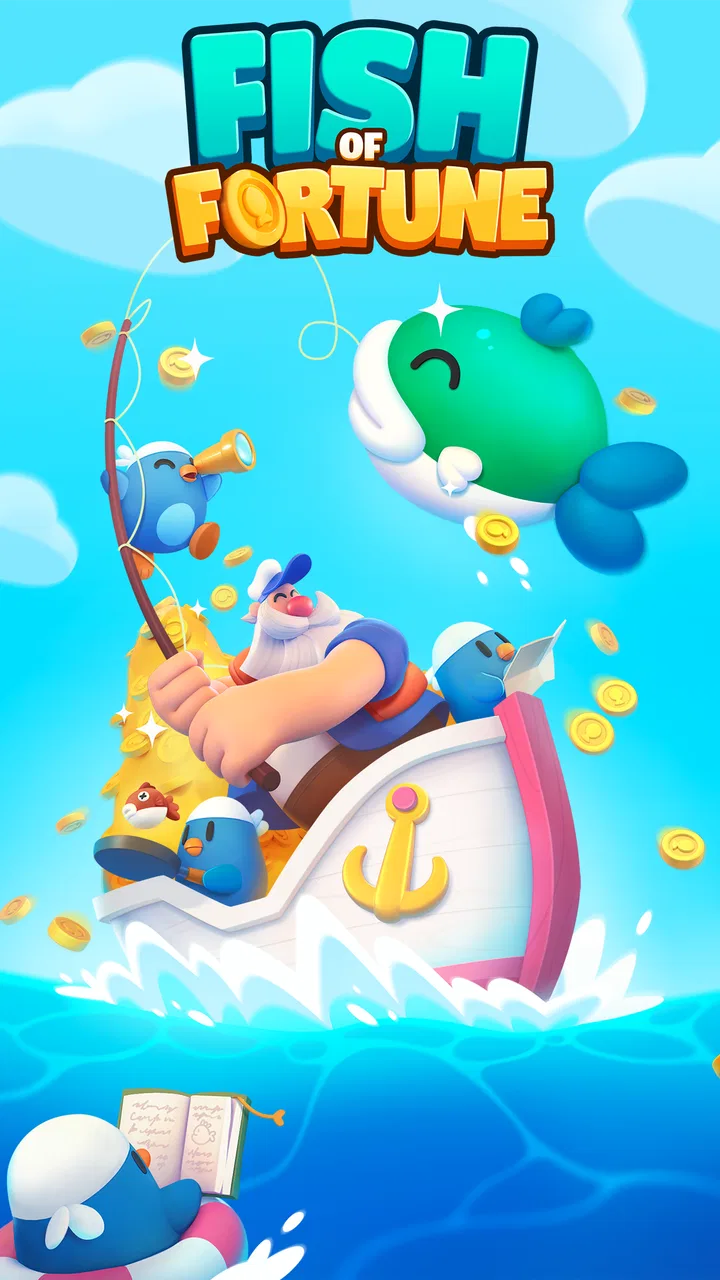
Fishing games usually promise a relaxing break, but the real test is what happens when I only have a minute to spare. Fish of Fortune™ makes a good first impression because its central idea is immediately understandable: I cast, catch fish, earn coins, and use that progress to develop an island. I do not need a long tutorial or a complicated explanation before I can enjoy the basic loop.
That simplicity is the main reason I can imagine recommending it to someone who wants a casual game rather than a demanding hobby. It is free to start, aimed at Everyone, and developed by Whalo. The game has also attracted a large audience, with over 1 million installs and an average rating of 4.8 from around 67 thousand ratings. Those figures do not replace personal experience, but they fit my impression that this is designed to be approachable, cheerful, and easy to pick up.
A fishing loop that works best in short bursts
The opening minutes are built around a clear exchange. Fishing gives me coins, and coins give me a reason to keep improving the island. That connection matters because it prevents the catches from feeling completely separate from the wider game. Even when I am only playing briefly, I have a small sense of purpose: make a little progress now, then return later to continue shaping the island.
You May Also Like

 Pandora - Music & Podcasts
Pandora’s Music Is Easy to Start, but Harder to Recover
Pandora’s strength is its low-effort path from a seed to a station. Its weak spot is how much confidence it asks you to place in connection, setup, and quiet recovery.

 8 Ball Pool
 Is Built on Rivalries, Rematches, and Routine
A close look at the rivalries, rematches, shared routines, and unanswered safety questions that turn a quick pool match into a persistent mobile community.

 Samsung Music
’s Quiet Strength Is Playing What You Already Own
Its reach comes less from spectacle than from dependable access to a personal library. That simplicity is both the app’s strongest retention engine and its ceiling.

 AccuWeather: Weather Radar
AccuWeather Review: A Quick, Clear Forecast for Everyday Decisions
For everyday plans, the best forecast is the one you can understand quickly. AccuWeather makes rain timing, radar, and local conditions easy to act on, with a few trade-offs.

 Hill Climb Racing
Why Hill Climb Racing Still Turns Crashes Into One More Run
A tiny car, a bumpy hill and one more upgrade: Hill Climb Racing keeps resurfacing because its simple chaos makes every near-miss feel personal.

 AliExpress - Shopping App
AliExpress Makes Global Shopping Feel Personal, but Shoppers Bear the Risk
AliExpress turns a global marketplace into a pocket-sized discovery engine. Its reach is useful, its shopping loop compelling, and its trade-offs easy to miss.
More From Our News Desk
View All News


I like that the game does not ask me to learn a large set of rules before the first satisfying action. The fishing itself is the immediate hook, while the island provides the longer-term reason to continue. This is a familiar structure in casual games, but here it suits the subject particularly well. Catching fish feels like the activity, and collecting coins gives the activity a visible consequence rather than leaving it as a series of disconnected taps.
For a short session, I would approach it with a modest goal instead of expecting a complete adventure every time. I might open it while waiting for coffee, play through a few fishing actions, spend the resulting coins if an island improvement is available, and close it. That kind of session feels more natural than trying to force a long play period from a game whose strongest quality is its low barrier to entry.
The first useful tip is to decide what kind of session I am having before I start. If I only have a moment, I focus on fishing and collecting. If I have more time, I use the island-building side to give the session a clearer finish. This small distinction keeps the game from feeling aimless, because I am not expecting every launch to deliver the same amount of progress.
Why the immediate pleasure is easy to understand
The pleasure comes from a compact chain of actions. I do something active, receive a reward, and see that reward connected to a place I am building. There is no need to memorize a complicated strategy to appreciate that rhythm. For players who enjoy watching a setting gradually become more developed, the island adds a welcome visual destination to the fishing.
That also makes the game suitable for people who are new to mobile games. A child or a casual player can understand the broad objective quickly, while someone more experienced can enjoy the convenience of a game that does not demand intense concentration. The Everyone content rating reinforces that accessible positioning, although adults who prefer deep systems may find the early simplicity too lightweight.
My main reservation is that the loop can feel narrow if I want every session to introduce something substantially different. Fishing, earning, and building are pleasant, but they are also the boundaries of the experience. The game is not the best choice when I am looking for a story-heavy campaign, a competitive challenge, or a complex management simulation. Its appeal depends on whether repeating a friendly routine sounds relaxing rather than predictable.
How the session rhythm handles interruptions
This is where the game makes the most sense for everyday use. I can imagine opening it during a commute, between household tasks, or while taking a short break from work. A game with a simple central action is easier to leave mentally than one that requires a long chain of decisions. I do not need to reserve a large block of time just to understand what I should be doing next.
A realistic scenario would be an evening when I have ten minutes before starting dinner. I can fish for a while, collect enough coins to make a small improvement, and stop without feeling that I abandoned a complicated mission. Later, I can return and recognize the same basic structure immediately. That continuity is valuable for casual play because it removes the pressure to remember a detailed plan.
I would still be careful about when I spend coins. The island-building element gives the currency a purpose, so spending automatically after every small gain may make progress feel less deliberate. I prefer to look at the available improvement first, then decide whether it gives me a satisfying stopping point. This is not a complex strategy, but it makes each short session feel more intentional.
The game’s current version is 1.151.10, and it runs on devices using Android 9 or later. For someone with an older phone or tablet, that minimum requirement is worth checking before getting attached to the idea of playing. On a compatible device, the low-complexity format should be comfortable for ordinary breaks, but I would not choose it specifically for demanding hardware performance or advanced visual technology.
Returning after a pause
The strongest pause-and-return quality comes from recognition. When I open the game again, the basic purpose is easy to recall: fish, collect coins, and use progress on the island. That is more forgiving than a game that expects me to remember a complicated build order or a long chain of objectives. It makes the experience friendly to irregular players who may play one day and then leave it alone for several days.
There is a trade-off, though. A simple return is not the same as a powerful reason to return. If I am motivated mainly by discovery, the game may lose some of its pull once the basic pattern becomes familiar. The island helps by giving progress a visible direction, but players who need constant novelty should keep their expectations realistic.
I also see value in using the game as a reset between more demanding activities. Because the fishing action is easy to understand, it can provide a small sense of completion without asking me to solve a difficult problem. That makes it a better fit for tired moments than many strategy or action alternatives. On the other hand, if I am trying to avoid all reward-driven mobile loops, this may not be the most satisfying kind of break.
Repetition, replay value, and the point where taste matters
Replay value here is based less on surprise and more on gradual progress. I return because there are more fish to catch, more coins to collect, and more island development to pursue. That structure can be quietly compelling when I enjoy incremental improvement. It is similar to tending a small digital project: each visit may be modest, but the accumulated result gives the routine meaning.
The important question is whether I enjoy the activity itself. If fishing feels pleasant to me, the island-building layer strengthens it. If I find the fishing repetitive after a few sessions, the coin and island goals may not be enough to change that reaction. The game does not hide its core loop, and that honesty is useful: it is better to decide based on whether this rhythm suits me than to expect a completely different type of game later.
Compared with a typical idle game, this feels more hands-on because fishing is the action I associate with earning progress. Compared with a puzzle game, it asks for less problem-solving and offers a gentler pace. Compared with a large farming or life-simulation game, it is easier to approach but appears less interested in giving me a broad set of responsibilities. I would choose it over those alternatives when I want a focused, low-pressure routine, not when I want a world packed with systems.
One non-obvious advantage is that the island gives me a natural way to judge whether a session was worthwhile. In many casual games, I finish a short visit with only a vague feeling that I tapped through some rewards. Here, the connection between fishing and construction makes the outcome easier to understand. I can ask myself whether I moved the island forward, rather than measuring the session only by time spent.
Another useful trade-off is that the same clarity can expose repetition quickly. There is nowhere for a complicated strategy to distract me from the main activity. That is good for players who want transparency and less good for players who rely on variety to stay interested. I would recommend trying the basic loop for a few sessions before making any purchase, because the question is not whether the concept is clear; it is whether the repetition remains enjoyable for me.
Free access and spending boundaries
The game is free, which makes testing the core experience straightforward. It includes in-app purchases ranging from $0.99 to $99.99 per item, so I would treat optional spending carefully, especially if children may use the device. The free entry is a genuine advantage for deciding whether the fishing-and-island loop fits my taste, but the presence of purchases means I would set a personal limit before playing regularly.
My practical approach would be to play without buying anything until I understand how often I return naturally. If I am already enjoying short sessions and the island progress feels satisfying, I can then decide whether spending improves my experience. If I am bored with the central loop, purchasing will not solve that underlying issue. In a casual game, the best value comes from enjoying the routine first, not from trying to buy motivation.
This is also where it differs from offline alternatives such as a simple puzzle or a one-time paid game. A free game with optional purchases is easier to try, but it may encourage me to think about progression and spending more often. Someone who wants a completely self-contained experience may prefer a paid alternative with a fixed structure. Someone who wants a no-commitment download and the chance to leave at any time may appreciate the free starting point here.
Who I would recommend it to
I would recommend Fish of Fortune™ to players who want a gentle casual game with a clear action and a visible sense of development. It suits short breaks, irregular play, and people who like collecting rewards that contribute to a growing setting. It is also a reasonable option for families looking for an accessible game, provided an adult keeps an eye on optional purchases.
I would be less likely to recommend it to someone who wants a demanding fishing simulator, a deep economy, or a competitive multiplayer experience. It is not the right pick for players who need a strong narrative to keep them engaged, nor for anyone who dislikes repeating a small set of actions. A puzzle game would be better for deliberate mental challenge, while a larger simulation would be better for players who want many interacting systems.
For me, the deciding factor is interruption tolerance. I can imagine stopping after a brief visit without feeling punished by the game, and that is a real strength. The island also gives the session more shape than a fishing activity based only on collecting catches. Still, the replay value depends heavily on personal patience: the loop is inviting, but it is not endlessly varied simply because the setting is pleasant.
Whalo has kept the concept easy to grasp, and the strong audience response suggests that the format works for many casual players. I would not treat the average rating of 4.8 or the roughly 3.4 thousand written reviews as a guarantee that every player will enjoy it, but they do make the game worth considering when its premise matches what I want from mobile play.
My casual verdict
Fish of Fortune™ succeeds when I judge it by short-session clarity, immediate pleasure, and the ability to survive interruptions. I can open it, understand the next action, make a little progress, and leave without a large mental commitment. That is exactly the kind of convenience I want from a casual fishing game on a busy day.
Its weakness is equally clear: the core routine may become repetitive for anyone who needs constant novelty or complex decisions. The island-building goal gives the catches more meaning, but it does not transform the game into a deep simulation. I see it as a focused relaxing pastime, not a replacement for a full adventure or strategy game.
With a free starting point, an Everyone rating, and support for Android 9 and later, it is easy to see why I would suggest giving it a try. I would play first without spending, use short personal goals to make each visit feel complete, and decide afterward whether the repetition still feels rewarding. If catching fish and gradually improving an island sounds like a pleasant way to fill spare minutes, this game is a friendly choice. If I need challenge, story, or constant change, I would look elsewhere.
FAQs for Fish of Fortune™
01What is Fish of Fortune™ and how does it work?
Fish of Fortune™ is an engaging mobile game where players dive into a virtual underwater world to catch a variety of fish and earn rewards. The game combines elements of strategy and luck, allowing players to upgrade their gear and unlock new fishing spots. It’s designed for both casual and dedicated gamers, offering daily challenges and in-game events to keep the experience fresh.
02Is Fish of Fortune™ free to play?
Yes, Fish of Fortune™ is free to download and play on both Android and iOS devices. However, it does offer in-app purchases for players who wish to enhance their gameplay experience. These purchases can include equipment upgrades, special bait, or currency packs. Players can enjoy the game fully without spending money, but these purchases can provide a strategic advantage.
03What are the system requirements for Fish of Fortune™?
Fish of Fortune™ requires Android 5.0 or iOS 11.0 and above to run smoothly. The game is optimized for most modern smartphones and tablets, ensuring a seamless performance. It’s recommended to have at least 200 MB of free storage space to accommodate future updates and ensure the game runs without any hitches.
04Does Fish of Fortune™ require an internet connection?
While Fish of Fortune™ can be played offline, an internet connection is required for certain features, such as participating in global leaderboards, accessing special events, and downloading updates. Playing online also allows players to compete with friends and join the community for shared achievements and rewards.
05What age rating is Fish of Fortune™ suitable for?
Fish of Fortune™ is rated for players aged 12 and up. The game contains mild fantasy violence in the form of fishing activities but is generally family-friendly. Parents can feel comfortable allowing their children to play, although supervision is recommended for younger players, especially when it comes to in-app purchases.
Pros
- Engaging gameplay with dynamic challenges.
- Stunning graphics enhance the fishing experience.
- Wide variety of fish and locations to explore.
- User-friendly interface and easy navigation.
- Regular updates with new features and events.
Cons
- In-app purchases can become costly.
- Requires a stable internet connection.
- Occasional ads interrupt gameplay.
- Limited offline features available.
- Battery consumption is relatively high.

Fish of Fortune™
Gallery